- NSIB opens probe into Challenger 604 door separation incident
- Private jet forced into emergency landing in Abuja after door detaches
- NAMA spokesman, Musa honoured with prestigious 'Dan Kade of Kontagora' title
- The sky has no gender
- Surging revenues, strong balance sheet drive United Nigeria’s pioneer ₦100bn debt programme



Nigeria-Accra Route: Lifeblood of Nigerian Regional Aviation

The Lagos–Accra corridor is currently the most competitive regional route in West Africa. The entry of new players and the expansion of existing ones have shifted the market from a stable duopoly into a high-frequency battleground, writes WOLE SHADARE
For decades, the Lagos-Accra air corridor has been the undisputed golden route of West African aviation.

With Nigerian airlines seeking dollar-denominated revenue to hedge against local-currency volatility, the 45-minute flight to Ghana has become the primary theatre of regional dominance.

Spanning just 250 miles—a mere 45-minute hop—this stretch of sky carries more than 50% of all regional air traffic in West Africa. But as we move further into 2026, the battle for these skies has shifted from a gentle rivalry into an all-out tactical scramble.
With new entrants like ValueJet and United Nigeria Airlines challenging Air Peace and Ghana’s Africa World Airlines (AWA), the Accra route has become the ultimate testing ground for the small-airline syndrome versus the continental-powerhouse ambition.
The landscape of the Lagos-Accra route has transformed significantly in the last six months. No longer a duopoly, the corridor is seeing a surge in capacity that is both a boon for travellers and a headache for yield managers
On March 30, 2026, ValueJet officially entered the fray with daily flights. Their strategy is clear: use the CRJ-1000—a right-sized aircraft that balances fuel efficiency with passenger comfort—to provide high-frequency, reliable service.
By targeting the 8:00 AM departure slot, they are aiming at the lucrative business-day-tripper market.

Having launched in late 2025, United Nigeria Airlines is using Accra as its springboard for a massive expansion in 2026. With a fleet set to hit 11 aircraft by mid-year, including Boeing 737-800s and Airbus A330s’, they aren’t just looking at Accra as a destination, but as a feeder for their planned long-haul flights to London and New York.
Ibom Air, on the other hand, continues to hold a steady share, leveraging its reputation for schedule reliability and its sleek Airbus A220 fleet, which remains a passenger favourite for the short hop.
|
Airline |
Frequency (Daily) |
Primary Aircraft |
|
Africa World Airlines (AWA) |
2–3 |
Embraer 145 |
|
Air Peace |
2 |
Boeing 737 / Embraer 195-E2 |
|
ValueJet |
1 (New) |
CRJ-1000 |
|
United Nigeria |
1 |
Embraer 145 / Boeing 737 |
|
Ibom Air |
1 |
Airbus A220 |
The commercial heat is being matched by diplomatic cooling. On March 9, 2026, the Nigerian Civil Aviation Authority (NCAA) and the Ghanaian Civil Aviation Authority (GCAA) signed a landmark Search and Rescue (SAR) Cooperation Agreement.

While technical in nature, this agreement is a massive psychological win for the industry. It signals a level of bilateral trust that has often been missing.
For Nigerian carriers, it means a safer, more coordinated airspace; for passengers, it’s a sign that the West Coast is finally maturing into a unified aviation bloc.
“Aviation safety cannot be achieved in isolation,” noted Capt. Chris Najomo, Director-General of the NCAA, during the signing in Accra. “This reflects African solidarity and a shared commitment to the Gulf of Guinea airspace”.
Despite the optimism, industry analysts are raising red flags about overcapacity. With nearly 10 daily flights between Lagos and Accra, the risk of empty seats is real.
The challenge for Nigerian airlines is no longer just getting the rights to fly; it is differentiation. Not a few expect aggressive promotional fares as ValueJet and United Nigeria fight for market share.
Most of these airlines are operating “point-to-point.” Without a functional transit hub at Murtala Muhammed International Airport (MMIA), Nigerian carriers are competing for the same Lagos-based business travellers rather than feeding passengers from the wider West African region into Accra.
The winners will be those who can bank their schedules—connecting a passenger from Kano or Enugu seamlessly through Lagos to Accra.
As experts at the recent Aviation Round Table (ART) noted, “small airline syndrome” remains a threat.
Without interlining and code-sharing, Nigerian airlines risk cannibalising each other while foreign carriers like ASKY and Air Côte d’Ivoire (set to enter the route in June 2026) use their hubs to siphon off international transit passengers.
The surge isn’t just about proximity; it’s about the Naira-Dollar Conundrum. Nigerian airlines earn in Naira but pay for maintenance, fuel, and spare parts in dollars.
International routes like Accra allow airlines to earn in more stable regional currencies or dollars, providing a natural hedge against the Naira’s volatility.
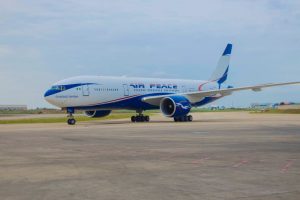
At approximately 250 miles, the route offers some of the highest yields per passenger mile in Africa. Airlines can charge premium regional fares for a flight that consumes significantly less fuel than a domestic Lagos–Kano leg.
The Chairman of United Nigeria Airlines, Prof. Obiora Okonkwo, recently at the FAAN National Aviation Conference in Lagos, with the theme, “Elevating the Nigerian Aviation Industry Through Investment and Global Engagements”, held in Lagos, said the over 200,000 seats on the Nigeria-Accra route make it the most lucrative route for Nigerian airlines.
Chief Executive Officer of Belujane Konsult, Mr. Chris Aligbe said one of the challenges the country airlines face is in the area of route development, adding that the carriers are constrained to route development because of its enormous cost; a position Okonkwo supported, admitting that it is very costly as it is for any Nigerian carrier to develop any route except they have tremendous resources to do that.
Launching the Accra route is often the first step for Nigerian airlines in their broader strategy to connect West and Central Africa.
The presence of many Nigerian airlines operating to Accra, Ghana, has several significant implications, primarily related to competition, passenger benefits, market saturation, and regional connectivity.
Although the saturation of the route by Nigerian airlines is not a recent event but a recurring pattern, experts consistently warn that the market is at or near saturation, making it highly precarious to sustain profitability.
The route is anchored by three steady pillars: corporate travel (banking and oil/gas), the “VFR” (Visiting Friends and Relatives) market, and a growing student population moving between both countries.
A 2026 directive aimed at abolishing air ticket taxes across West Africa is expected to slash fares by up to 25%, potentially unlocking a massive middle-class market that previously found flying too expensive.
Ghana’s Kotoka International Airport is positioning itself as a West African gateway. Nigerian airlines are eager to feed their passengers into this ecosystem to connect with long-haul carriers flying to Europe and the US.
The foray into Accra is a bold litmus test for the maturity of Nigerian aviation. Success won’t be measured by who flies the biggest planes, but by who manages their fleet most efficiently.
Under the Single African Air Transport Market, it is becoming easier (though still challenging) for airlines to secure fifth-freedom rights. This allows a Nigerian carrier to fly from Lagos to Accra and then pick up new passengers in Accra to fly on to a third country, maximising profit on every seat.

The move by ValueJet and Ibom Air to use right-sized regional jets (CRJs and A220S) suggests a shift toward profitability over prestige.
The Accra route is no longer a luxury add-on; it is the lifeblood of Nigerian regional aviation. For Air Peace, the goal is to defend its territory. For ValueJet and United Nigeria, this is a proof of concept for regional relevance.
Google+